Dead and Hazardous Tree Removal in Concord, NC
Precision dismantling of high-risk trees threatening homes, garages, driveways, and property lines. We specialize in dangerous dead pines, rotting oaks, split Bradford pears, and tight residential removals using advanced rigging and crane support.
Common Signs You Need Dead & Hazardous Tree Removal in Concord
If you observe any of these conditions around your home or property boundary, professional attention can prevent costly structural damage.
Signs a Tree Is Dead, Dying or About to Fail
A tree does not have to be completely dead to pose a catastrophic threat to your family and home. In Concord's Piedmont landscape, structural failure often begins invisibly inside the trunk or root system. Key warning indicators include extensive crown dieback, bark falling off in large sheets, deep carpenter ant activity, trunk cavities filled with soft wood rot, and fungal mushrooms (fruiting bodies) growing directly from the root flare. If more than 40% of a tree's canopy fails to leaf out in spring, the root system is collapsing and the tree should be professionally evaluated.
Leaning Trees, Split Trunks and Lifting Root Plates After Heavy Rain
Cabarrus County's dense Piedmont red clay soil has high water retention. During tropical rain events and multi-day summer thunderstorm patterns, the clay becomes completely waterlogged. Heavy canopy weight combined with gusty winds can easily lever the shallow root systems of loblolly pines and mature oaks right out of the slippery soil. If you spot a fresh mound of lifted dirt, snapped anchor roots, or a widened fissure running vertically through a main trunk crotch, the tree is under intense mechanical tension and can fail without warning.
Taking Down Large Trees Close to Houses, Fences and Sheds
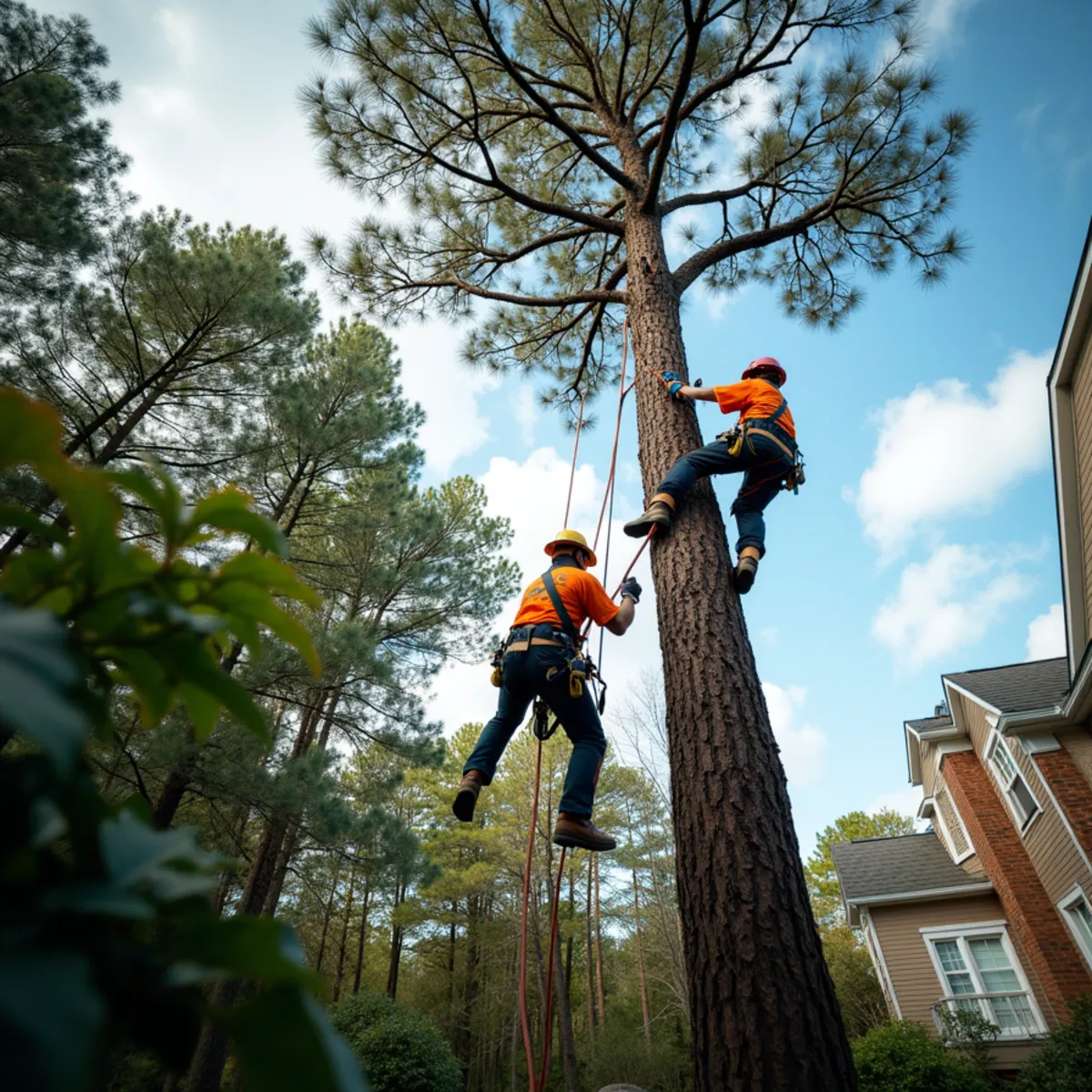
Removing an 80-foot hardwood situated just 6 feet from your bedroom wall or over an expensive patio enclosure demands technical rigging expertise. Our crews employ modern arboricultural rigging techniques: climber ascents, friction brake lowering systems (portawraps), and high-strength synthetic bull ropes. By sectioning the tree from the top down and directing each cut with taglines, we lower massive timber sections with pinpoint control, protecting shingles, gutters, decks, and underground septic fields below.
When a Crane Is the Safer Way to Remove a Tree
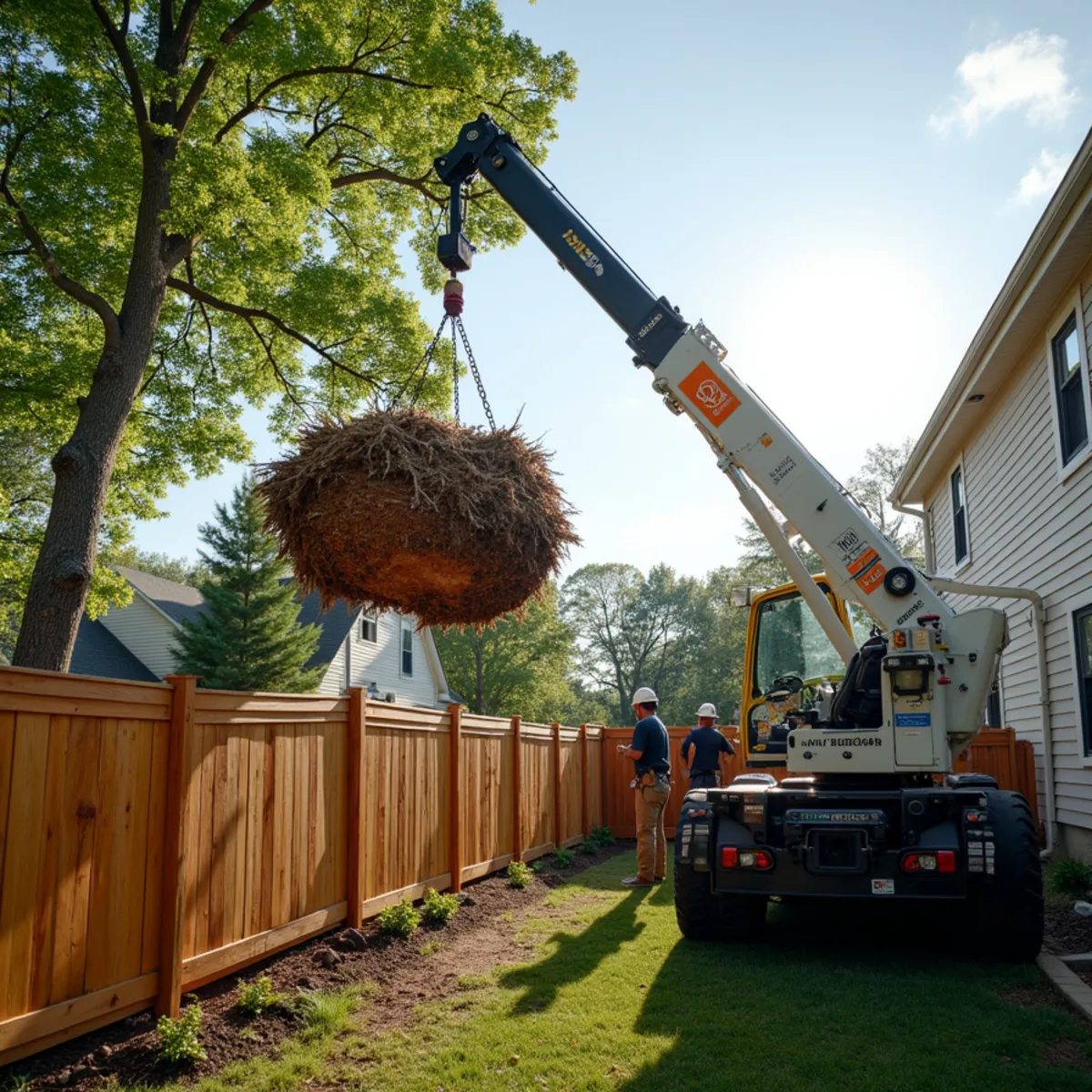
When a dead or storm-damaged tree is structurally hollow, brittle, or rotted through the core, it is unsafe for a climber to ascend and cannot support rigging forces. In these scenarios, crane-assisted tree removal is the safest, most efficient method. A mobile crane hooks directly into the tree section before our sawyer makes the cut. Once severed, the crane lifts the multi-ton branch straight up into the air, over your roof, and deposits it safely onto your driveway or flat lawn for processing.
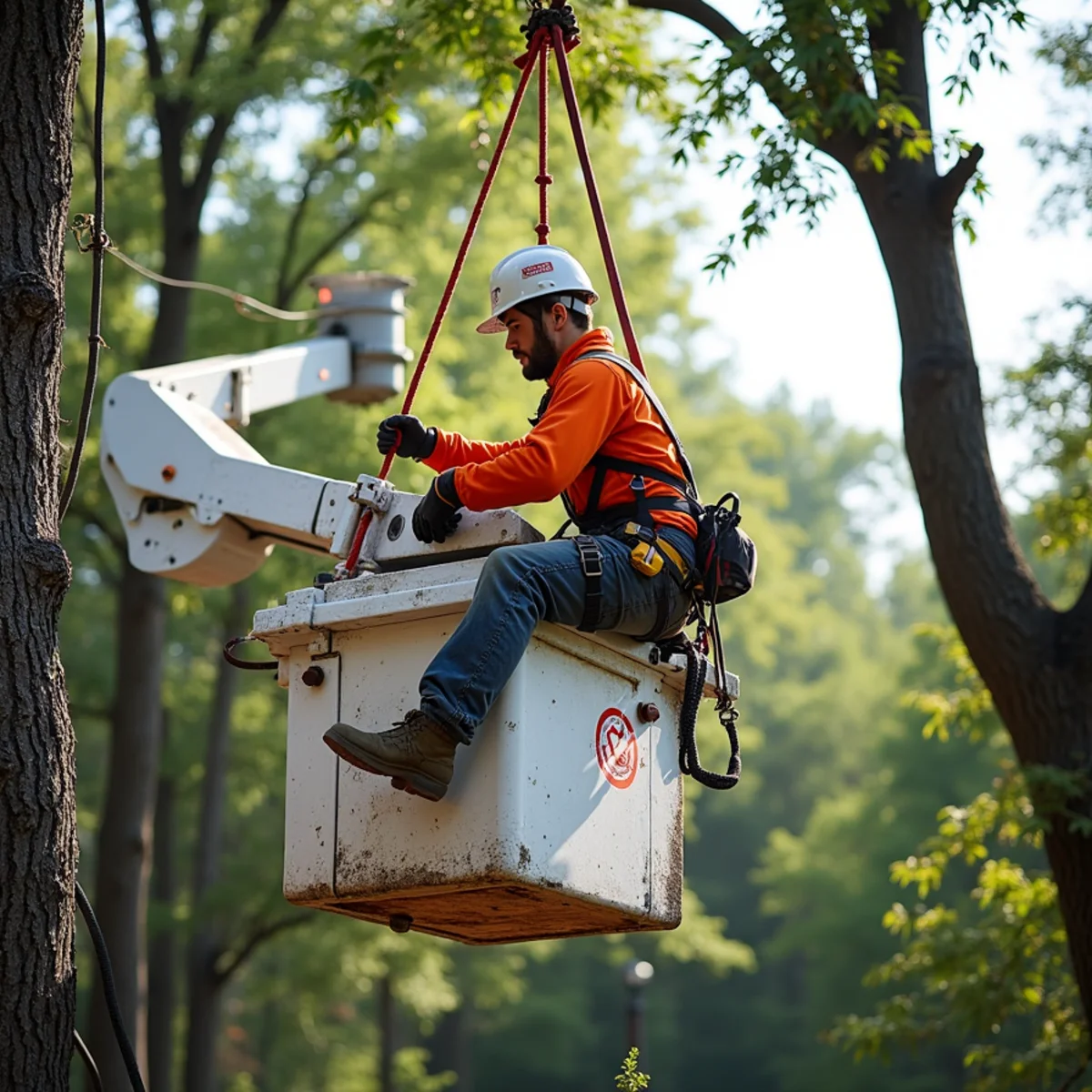
Machinery & Rigging Used for Dead & Hazardous Tree Removal
We deploy modern arboricultural equipment tailored to your yard's access conditions to protect roofs, lawns, and utility drops.
How Common Concord Trees Fail: Pine, Oak, Sweetgum and Bradford Pear
Different local species exhibit predictable failure mechanisms in our region: Loblolly pines suffer shallow root-plate blowover in wet clay or sudden mid-trunk trunk snaps during wind shear; Willow oaks develop hidden interior heartwood decay in older crotches; Sweetgums drop heavy, brittle limb sections during dry summer heat; and Bradford pears almost universally split down their crowded central V-crotches under modest wind or winter ice loading.
Dead Ash and Other Pest-Killed Trees: Why Waiting Makes Removal Harder
Emerald ash borer is now established across North Carolina, killing hundreds of native green and white ash trees throughout Cabarrus and surrounding counties. Ash trees killed by the borer dry out rapidly, becoming extremely brittle within months of death. Unlike oaks that retain wood elasticity for a period after dying, dead ash wood snaps unpredictably like glass. Waiting to remove a dead ash tree dramatically increases the danger and often forces expensive crane setups because the tree becomes unclimbable.
Our Step-by-Step Dead & Hazardous Tree Removal Process
1. Hazard & Target Risk Assessment
We analyze tree species, lean angle, structural decay percentage, ground stability, and target zones (roofs, utility lines, sheds, neighboring homes).
2. Rigging or Crane Mobilization
We establish a secure drop zone and outrigger placement. When close proximity prevents a controlled drop, crane tie-off or rope friction systems are deployed.
3. Controlled Sectional Dismantling
Canopy limbs are removed piece by piece from top to bottom. Each log section is strapped, cut, and mechanically lowered or crane-swung to the ground.
4. Trunk Sectioning & Ground Cleanup
The remaining main trunk is cut into manageable rounds, loaded with grapple machinery, and all fine debris is swept and raked spotless.
Whose Tree Is It? Property Lines, Neighbors and HOA Rules
Trees standing along property boundaries frequently raise questions between neighbors. Under North Carolina common law, if a healthy tree or branch falls onto your property due to an Act of God (severe storm), you are generally responsible for clearing the debris on your own property, while your neighbor clears theirs. However, if a tree was visibly dead, rotten, and hazardous—and the owner was previously notified in writing—liability can shift to the tree owner for negligence. We provide objective written hazard assessments to help resolve boundary tree safety issues amicably.
What Affects the Cost of Removing a Large or Hazardous Tree
Hazardous tree removal pricing reflects the risk profile and equipment deployment. Key factors include: tree height and wood volume; whether climber rigging, an aerial bucket, or a crane is required; access limitations (backyard fences, steep slopes, soft septic grounds); proximity to electrical service drops; and the degree of cleanup, log removal, and stump grinding specified in the written estimate.
What Moves the Price of Dead & Hazardous Tree Removal in Concord?
Hazardous tree removals typically range from $850 to $2,500+ depending on crane necessity, tree height, and structure proximity. Metro high-end jobs can reach $9,730.
- •Tree height, trunk diameter, and total green timber weight
- •Proximity to homes, power lines, decks, swimming pools, and septic fields
- •Tree structural integrity (dead, rotten trees may be too brittle to climb safely, requiring crane access)
- •Crane setup requirements vs. bucket truck vs. manual rigging access
- •Stump grinding and complete wood chip / log haul-off
Why Property Owners Choose Cabarrus Tree Crew for Dead & Hazardous Tree Removal
Tree care requires specialized heavy equipment, rigorous safety protocols, and deep botanical knowledge of native Piedmont hardwoods and conifers. Here is what sets our service standard apart in Concord and Cabarrus County:
Licensed & Fully Insured
Every crew operates with active general liability and North Carolina Workers' Compensation coverage (satisfying NC mandatory compliance for 3+ employees), shielding you completely from on-site injury liability.
Upfront Written Price Lock
We never start a chainsaw without providing a clear, itemized written estimate. Your quoted price is locked before mobilization begins—no hidden disposal or equipment surcharges.
24/7 Local Live Answering
Our dispatch telephone line is answered live 24/7/365. Whether addressing storm blowdown at 2 AM or scheduling routine seasonal pruning, our local team coordinates prompt on-site assessments.
ANSI A300 Tree Standards
We adhere strictly to ANSI A300 arboricultural specifications and ANSI Z133 safety mandates. We protect branch collars, refuse destructive tree topping, and deploy heavy ground mats to preserve your lawn.
Dead & Hazardous Tree Removal FAQs
How do I know if a leaning tree is dangerous?▾
Can you remove a tree that hangs over my house without damaging the roof?▾
Do I need approval to remove a tree on my own lot in Concord?▾
Is stump grinding included with a tree removal?▾
What if a dead tree is too fragile, hollow, or rotted for an arborist to climb safely?▾
Ready for an On-Site Inspection & Written Quote?
Our insured crews are ready across Concord, Kannapolis, and Harrisburg. Call (321) 478-0689 now.
Related Tree Services
Service Area & Local Response Corridors
From our central hub in Concord, our equipped crews deliver prompt dead & hazardous tree removal across Cabarrus County and adjacent Piedmont communities. We routinely travel major transit arteries including I-85, US-29, NC-49, NC-73, and Poplar Tent Road to provide rapid emergency mobilization and timely routine estimates.
Not Urgent? Request a Written Quote for Dead & Hazardous Tree Removal
Fill out this form and a tree specialist will contact you with pricing and schedule options.
Speak With Our Dispatch Team
Have questions about a hazardous tree or need same-day storm clearance? Call our Concord dispatch line directly.
(321) 478-0689We Service Your Area
- Concord, NCHub (0–10 min)
- Kannapolis, NC10–15 min
- Harrisburg, NC15–20 min
- Midland, NC20–25 min
- Mint Hill, NC25–35 min